The Career Stage Nobody Prepared You For


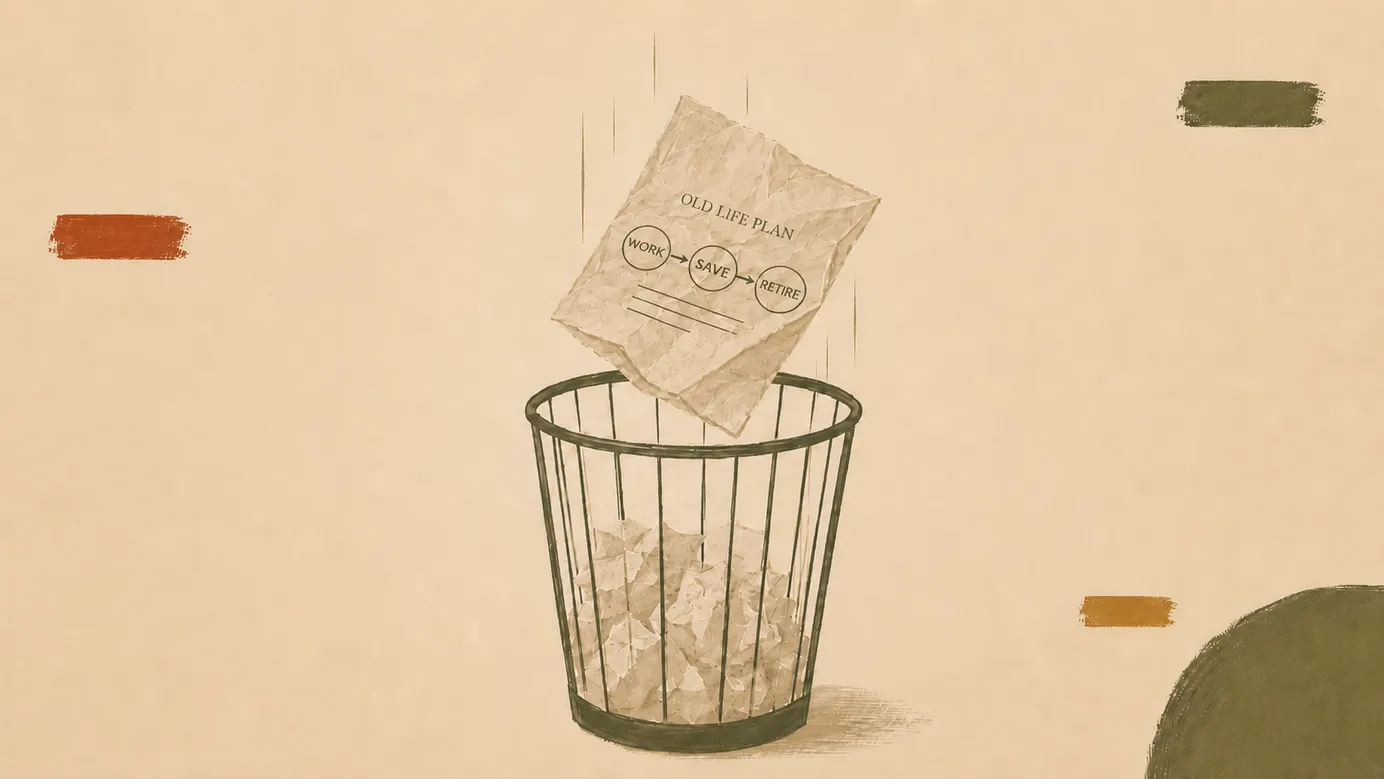
Summary: The career ladder was built for ascent and exit. It had very little to say about the long, uneven journey between the two, where capability remains, but the old structure no longer gives useful instructions.
End of the Road
George Clooney built a career out of playing men who are good at what they do and yet are uncertain about what that means.
That quality finds its sharpest expression in the movie Up in the Air. Clooney’s character has everything the career system promised: status, expertise, a first-class seat, and a job he’s genuinely good at.
Vera Farmiga plays the woman who holds up a mirror. What she reflects back isn’t failure or poor character, but something much harder to describe: a person who still has everything except somewhere to go.
What the film captures – better than most career writing manages – is the feeling of being genuinely competent inside a system that no longer offers a meaningful next step.
Most people in that position never make a film about it. One day, you simply notice that the next step has become harder to name. You still have your expertise and ability, your energy, your motivation, your contacts, your judgment, and your desire to be useful.
You are far from done.
But the structure that once organised your working life has started to feel less solid. For years, work gave you a scoring system. It may not have been perfect or fair, but at least it was recognisable. Promotion meant progress, salary meant value, responsibility meant trust, and there was a growing sense that your experience was actually being used. At least you felt you were moving in the right direction.
Even frustration had a certain order to it. You usually knew what you were frustrated by. Your path might have been blocked. Or it was that terrible manager. Or an opportunity you failed to spot. A role that had shrunk. Yes, the system was imperfect, but at least you could read the signals.
And the ladder did more than just organise promotions. It also organised meaning.
You knew what counted as progress: a better title, a larger team, more responsibility, a bigger salary, a seat closer to the decisions. Even when the work was dull or frustrating, you still knew what the system required. Do more, carry more, rise further. That silent contract was hard to ignore.
But there comes a point when the scoring system starts to fail. Your next promotion may no longer feel like progress. The role that promised greater responsibility turns out to demand a version of you that costs too much to maintain. And even though your flashy new job may turn a few heads, your life around it may still deteriorate. What once looked like advancement starts to look like more like the same, only harder to refuse.
At that point, it’s not your ambition that falters. It’s direction.
Staying where you are feels too narrow. Moving up costs too much. Leaving feels premature. Starting again feels completely absurd. And retirement feels too blunt a word for someone who’s still alert, capable, and far from finished.
It’s not as if you’re out of options. There’s always another role, a smaller role, some consulting, a project, a part-time position, a business you could set up, a skill you could teach, a board or trustee role, or a return to something you once cared about. But none of these quite offer the same authority, recognition, or identity the old career ladder used to provide.
Yes, you still have judgement, energy, and mental sharpness. Years of experience have given you something harder to fake: a feel for people, systems, risk, timing, politics, the bullshit detector, customers, money, pressure, leadership, and consequence.
And yet, one question no longer behaves in the same way it used to:
What next?
The Ambiguity of Arrival
In theory, this is the point in life where the question was supposed to become clearer. After all, you’ve done what the system asked of you: kept going, put in the years, took on more responsibility, built your reputation, became useful, trusted, the kind of person younger colleagues came to for judgement, context, and the bit of history nobody had written down.
And then at some point, you arrived.
Or at least that’s what it was supposed to feel like.
For much of our lives, ‘peak career’ is made to sound like a destination – the point where your expertise has accumulated, your effort has paid off, the point that earlier stages were supposedly built towards, where you can finally let out a deep sigh.
You’ve arrived.
But many of us do not experience it like that. It feels less like reaching the summit and more like passing through a strait. Everything narrows.
Once you reach a certain point, the old game changes. There may be plenty of possible moves, but fewer that arrive with the old sense of direction. Staying where you are may mean doing work you can still do, but no longer quite believe in. Taking on more responsibility may bring status, but at a cost you no longer want to pay. Taking on less may make life easier, but feel uncomfortably like retreat. Leaving can feel premature. Starting again can feel faintly ridiculous. And stopping altogether may feel far too blunt for someone who is still alert, capable, and far from hanging up their hat.
And that is the weird ambiguity of arriving at peak career. You may still be experienced and capable – in many ways, more than you’ve ever been. But the old structure has fewer useful instructions to offer you now. It was built to reward the climb. It also knows how to process the exit. But it is far less fluent in the long, messy, uneven territory between the two – which is exactly where you may now find yourself.
And it turns out you’re not alone in feeling this. Research suggests that, among highly skilled workers, the discomfort of this period has less to do with personal failure or psychology than with how the world of work was constructed in the first place.
That matters. Because if the problem around work is structural rather than psychological, it’s not about you being more energetic, more motivated, more resilient, or more willing to make a change. The question is whether the system was ever designed to make good use of someone like you.
The Problem Isn’t Always Capability
The challenge is that the value you carry at this point is often less visible to the outside world.
Earlier in your career, usefulness is easier to display. You complete the task, hit the target, earn the promotion, take on a larger role, and deliver the visible result. And around it goes.
But later, some of the most valuable things you know are less obvious to others. You can tell when a room is pretending to agree, or when a customer is losing trust before the spreadsheet shows it. You can almost smell a weak plan or spot a mistake someone is about to make because you’ve seen it before.
That is not nothing.
But it is not always easy to package, price, promote, or fit neatly inside a job description. That’s where things get complicated. Because you may still have enormous value, but the employer may not have a good category for it. You may still have a range of skills, but the system may only be buying a narrow slice of you. Yes, you are capable of far more – but of what? More of the same?
The truth is that organisations often struggle to recognise the value that doesn’t sit neatly inside a job description: judgement, context, customer knowledge, institutional memory and relationship capital.
That does not make you obsolete. But it does mean the matching system is poor: capability and placement aren’t the same thing. You can be experienced, alert, emotionally steadier than you have ever been — and still find yourself badly placed by a system that no longer quite knows what to do with you.
That is one of the quiet humiliations of this stage of life. Don't for a second think it's the loss of your ability.
It's the loss of fit.
That brings us to something even stranger: experience is supposed to be exactly what the system wants. It’s celebrated in leadership books, praised in job descriptions, worshipped in movies, and invoked in every speech about what great organisations are built on — judgement, perspective, resilience, relationships, battle scars, and the useful suspicion that comes from having seen the messiness up close.
Up close however, experience can start to look inconvenient.
Too expensive. Too senior. Too fixed in your ways. Too slow. Too hard to manage. Too close to retirement to be worth the investment. Too unlikely to tolerate nonsense. Too much.
The system says it wants experience — right up to the moment when an experienced person walks through the door.
That’s the absurdity of it all. The very thing you spent decades accumulating can become part of the reason you’re harder to place. Yes, your experience still has value. It just comes with history, standards, expectations, and a life that may no longer bend itself around work quite so easily.
If you’ve sensed this, you’re not imagining it. UK research on recruitment ageism suggests that experience itself can become a strange disadvantage, with some older applicants treated as if they have too much of it.
And it’s not always loud. Sometimes it appears in the small mechanics of working life — the meeting you are no longer invited to, the project given to someone hungrier, the training offered to younger colleagues, the shortlist you never quite make, the role that seems designed for someone earlier in the climb.
Nobody will ever say "too experienced" directly. It is the unspoken conclusion.
And so you are left with a strange contradiction: you did what the system asked, accumulated the experience, and then found that the system had become unsure what to do with it.
The Lines are Dissolving
Part of the reason the system struggles is that the old definition of ending has broken down too.
For a long time, work was supposed to have a nice tidy shape. You worked, you advanced, you reached a later stage of your career, and then you stopped. After that, you moved into a new life phase called “retirement” – a different category with different expectations. Work belonged on one side of the fence. Leisure, rest, family, travel, recovery, or later life meaning belonged on the other.
That fence has now collapsed.
You may still be working, but not in a way that feels like the old career. You may still be earning, but not from one clear source. You may still be useful, but not through a role that makes your usefulness obvious. You may be partly in work, partly out of it, partly building something new, partly trying to work out whether the old structure still has any claim on you.
You may have chosen to do this. Or you may be doing it because you need the money. Or because you want to feel useful. Or after a lifetime of raising children followed by a divorce, you’re back on your own. Or because simply stopping feels wrong, even though continuing in the old way no longer quite fits.
Work doesn’t always stop. It just changes its shape before you have the language to describe the shape.
If your working life has started to look like this, you’re not some strange exception. In the UK, research on later-career work shows that it often tapers, fragments, resumes, or shifts into part-time and self-employed forms rather than ending in a single, clean movement.
This is one of the reasons the question “what do you do?” becomes harder to answer. That question used to ask for a role.
Now, for many people, it’s seeking an explanation.
You may still work, just not in the old conventional way. You may still earn, but not from one source. You may still contribute, but not through a title that makes the contribution obvious. You may still be building something, but not in a way that looks like a conventional career.
This is where work begins to reveal the larger postlinear condition: the old life sequence can no longer contain its neat, orderly shape.
The issue is not only that careers have changed. It’s that the boundary between work, identity, money, time and usefulness has become far messier than the old model allowed, which is why the blurring of work and retirement can feel heavier than most people realise.
Work is rarely just work.
It is income, yes. But it is also rhythm. Recognition. Status. Routine. A place to be expected. A reason to be in the room. A reason to give back. A way of being introduced. A story. A shorthand that other people understand.
Work gathers meaning in ways that are easy to miss when you’re in the thick of it. It holds parts of your life together while holding up the pretence that it’s just a job. So when work stops organising your life as it once did, the loss is not only practical. It’s also structural.
You don’t just lose hours, income, status, or a title. You also lose part of the structure that made your usefulness visible.
That’s much more difficult to name than losing a salary. It may show up as a flatter week, a reluctance to explain what you’re doing these days, or a discomfort when someone asks: so are you retired? It’s that strange sense that people no longer have an easy shorthand for who you are or what you do.
You may not feel less capable. But you may no longer have a simple answer for who you are in the world.
If that feels uncomfortably familiar, there’s a reason. Research on professional identity after retirement and late-career transition suggests that status and social recognition continue to matter long after the formal role changes.
That should not surprise us. Work gives us more than income. It gives shape, recognition, contact, proof of usefulness, a sense of purpose and identity, and a place in the world. When that starts to fall away, there’s a hell of a lot more than employment being disturbed.
So when work after peak career becomes ambiguous, the uncertainty is not simply about income, schedule, boredom, and what to do with your week.
It’s about placement.
Where do you belong when the old structure no longer gives you an obvious place? Where is your experience actually wanted? When does what you know become useful in a way other people can see? And where can you contribute without pretending to be at an earlier stage of your working life?
The New Forms Aren’t the Full Answer
This is where the language of work can become both useful and misleading.
Portfolio careers. Fractional roles. Advisory work. Consulting. Independent projects. Small businesses. Part-time work. Trustee roles. Mentoring. Teaching. A patchwork of income, contribution, and usefulness.
Many of these forms can be liberating. They can give you back a degree of control and let you use your experience without submitting to another full-time structure. They can also leave room for other pursuits: health, learning, travel, or simply a different rhythm of life.
But they are not yet a system.
They’re the signs of a labour market trying to improvise around a missing structure.
That distinction matters.
Because the existence of these newer forms can make it look as if the problem has been solved. It’s as if the answer to work after peak career is simply to become more flexible, more entrepreneurial, more networked, and more comfortable with uncertainty.
For some people, that is indeed true. But for others, it’s much less simple.
These forms often depend on reputation, contacts, timing, confidence, savings, health, geography, market demand, and the ability to explain your value without the borrowed authority of a job title. Yes, they can be liberating. But they can also be fragile.
They can provide autonomy, but not always belonging. They can create income, but not always a sense of rhythm or momentum. They can use your experience, but they don't always make it as visible as the old structure once did.
So the fact that these forms are growing tells us something important.
It doesn’t mean that everyone needs to become a consultant. Nor does it mean that you’ve neatly replaced your old career with a better system. It means that the old choices – keep climbing, keep your head down, stay put, step down, or retire – no longer describe the lives many people today are now trying to build.
These newer forms might indeed be a small part of the answer. But for now, they’re still workarounds, not a complete structure. They are arrangements people actively shape for themselves once the old fence between full-time work and retirement has started to rot away.
Not Yet Finished
And so we go full circle, back to the question we asked ourselves earlier.
What next?
For a long time, the professional question was relatively simple, even when the answer was difficult.
What is the next role?
What is the next promotion?
What is the next title?
What is the next move up?
Those questions made sense when the old structure still held together. They belonged to a world where work could be understood as a climb, and progress meant moving further along the same “path.”
But after peak career, what next? may need to mean something different.
The better question might be: What form should my contribution take now?
That question is less tidy. But at least, it’s more honest. It leaves room for income, without reducing work to income. It acknowledges status, without pretending status is the whole point. And it makes space for rhythm, autonomy, usefulness, energy, health, family, confidence, and the kind of life that now needs to exist around work.
It also allows for something else: the possibility that this is not a competence problem.
You may not need to become a different person, perform some grand reinvention, or pretend you are earlier in your working life than you are. You may simply need a different structure for the person you have already become.
That’s the part the old career ladder never prepared you for. It knew how to reward the climb and how to recognise advancement. It even knew how to process retirement.
But it had very little to say about this new middle territory – the interlude – where you are still capable, still experienced, still useful, but no longer easily contained within the old structure of work.
And that may just be where you find yourself now. Neither outside of work, nor fully inside the old version of it either. Unfinished – and in a place the old system never properly named.
Perhaps that is why Up in the Air still resonates today. It’s not really a film about travel, status, or the glamour of being untethered. It’s about someone who has become extremely good at moving through a system that can no longer tell him what all that movement is for.
At some point in our lives, the mirror goes up. And what it shows isn’t failure, but the space between structures, the interlude. Once you see that, you can change the question again.
It is no longer: what should I do next?
It is: where does my value belong now?
And work may only be the first place you notice it.
Because, as with everything in this messy world of ours, it rarely comes down to one thing.