Why The Fix Didn't Fit It

Summary: Sometimes you change the job, move house, make the plan, have the conversation, or take the break — and still the pressure remains. The problem may be real, but it may not be the actual source.
When life starts pressing from several directions, the loudest problem may not be the actual source.
The Problem That Keeps Moving
My mother came home from the doctor one afternoon, furious. She’d gone in about an ache in her shoulder that flared each time she lifted something or reached too high. After examining it, the doctor apparently shook his head and said: It’s not the shoulder, not really.
I remember my father chuckling from his armchair. So you have a pain in the shoulder, but the doc’s telling you it’s not the shoulder?
It turns out, the doctor was right.
What my mother felt was real. There’s even a medical term for it: referred pain. A pain appears in one part of the body, but the underlying problem lies somewhere else. A problem in the lower spine, for instance, can send pain all the way down to the toes.
Life can work that way, too.
Your job starts to feel frustrating, or you find yourself dealing with money or relationship issues. So you reach for the obvious fix: step back, make a plan, have the conversation, or change the routine.
And yet, days or weeks later, the original frustration remains.
Most of us have been there. Something starts to hurt. It may not even be something big. Just enough that you start to notice it – a niggle that interrupts the flow of your day. Like an itch, it’s enough for you to start pointing to it and thinking: There it is. That’s the problem.
The job has become heavy. Money feels tighter than it should. The house no longer feels quite right. The relationship has gone off the tracks in places. The days feel monotonous. Or you’re constantly tired in a way that sleep doesn’t explain.
That’s when you do the only reasonable thing. You start with what you can see. You start with the job, the numbers. You replay that conversation in your head. You tell yourself you need a break, a plan, a decision, a change of scene.
And often, you do.
But pressure rarely stays isolated. Often, it turns out to be the meeting point where several other things have gathered. In fact, research confirms that major life transitions such as retirement, bereavement, and relocation often do not arrive neatly one at a time.
One shift alters the shape of the others. Moving house reshapes a friendship. A job change strips away identity. A health scare reframes money. A child leaving home changes the sound of the house.
So the first thing you notice may simply be where the pressure has gathered.
The loudest problem may be very real, but it may also be the place where something deeper has surfaced. Something that was always there, but needed a trigger to become visible. And because work has carried so much for so long, that is often where the pressure first appears.
Work Carries Too Much
That makes sense when you think about it. For much of your adult life, work has been one of the main structures holding everything else in place. It gives the week its shape. It tells you where to be, what matters, who expects something from you, and what counts as a good day.
But there’s more to it than that. Work carries rhythm, status, contact, usefulness, identity, proof that you’re still moving, still needed, and still part of the machinery of things. For many of us, work has been the scaffolding of our entire lives – not just of our careers, but our sense of who we are.
So when work starts to feel as if it’s wrong, the natural conclusion is that work is the problem.
And it may indeed be the case. Maybe the job has become too demanding, or the organisation has restructured, or you may no longer feel aligned in terms of your energy, values, or stage of life. You may have reached the point where the old bargain has simply worn out.
But sometimes work is just the crossroads where everything else in your life decides to congregate.
When your job stops meaning what it once did, your identity can start to shift with it. When there’s suddenly less to fill the week, time starts to feel uncomfortable. When income becomes uncertain, money stops feeling practical and starts feeling personal. When the children leave, the house feels like a cave. Or when a parent needs care, your own future comes rushing into view.
None of this shows up as a work problem. But all of it can surface there first – because work was the keystone holding all the other parts of your life in place.
That’s why changing the job doesn’t always change the pressure. Sometimes the job was nothing more than the container. Once it cracks open, you begin to see what else it had been supporting.
Once you see that, it's really quite hard to unsee. Work is not only work. Money is not only money. A house is not only a house. A relationship is not only a relationship. By this point in life, we realise most things have been carrying other things for a very long time.
Take money, for example. What could be more straightforward than numbers, accounts, pensions, savings, and outgoings – the kind of thing we assume is solved with a spreadsheet and a sensible plan?
But money rarely stays that tidy. Money carries permission — it allows you to make a choice. It also carries safety, pride, fear, independence, or the dread of one day having to rely on someone else. So when money starts to feel tight, the anxiety you feel isn’t just about the number. It’s about your options narrowing and your future feeling less certain.
Relationships work the same way. Initially, the issue might be down to poor communication, or distance, or a constant annoyance that neither of you can put a name to. But below the surface, there are often old agreements about who carried what, who waited, who adapted, who sacrificed or compromised more, who kept things moving along, and who quietly made room for the other to become themselves.
So when a relationship starts to feel strained, it’s not just affection and love that it’s carrying, but also time, duty, care, disappointment, and the unspoken question of what the next part of life is supposed to look like — together.
Place is no different – and it may be the most underestimated of all. A house can look like a practical question: too large, too small, too expensive, too far away, too full of memories, or too empty in the wrong rooms. But where you live also carries the story of your life: roots, belonging, routine, neighbours, habits, the routes you know without thinking, and the memory of who you were when you first arrived there.
That is why the question "Should we move?" is rarely only about moving. Once you strip away the familiar setting around you, it could be about who you are.
And then there are roles we play in life. Sociologists have long studied what happens when people leave roles that once organised their identity. A role is rarely just a title. Parent. Partner. Founder. Director. Provider. Carer. Expert. The reliable one. The ambitious one. The one who copes.
Each of those words carries a set of instructions. They tell you where to be and when, what to prioritise, what to put aside, and how to measure a good day. They tell the people around you what they can expect from you, and what they don’t need to worry about – because you have it covered.
In that sense, a role is less a label and more a daily operating system. It organises your time, your attention, your energy, and your sense of whether things are going well. So when a role stops fitting — whether it’s a job title, a family position, or simply the person everyone knows you to be — the disturbance doesn't stay politely inside that role. It leaks into time, money, relationships, confidence, energy, and the way you recognise yourself when you unexpectedly catch your reflection.
But in our messy lives, very little sits in one container anymore, and we rarely notice how much we’ve been treating them as if they do. Tug at one part of life, and it yanks at the others surrounding it. And before long, the thing you thought you were fixing has become part of a much wider embroidery.
The First Explanation
When everything is tugging at everything else, the mind does something very human.
It simplifies.
It has to. Our brains are wired to reduce complexity into something manageable, something we can act on. When too many things are moving at once, life becomes genuinely hard to read. So you reach for the cleanest explanation available — the one that gives the discomfort a label, a handle, somewhere to begin.
We say: I need a new job.
Because it’s much harder to say: The structure that used to organise my work, my identity, my money, my time, and my sense of belonging no longer seems to be doing its job.
We say: We need to move.
When the true sentence should be: This place used to fit my life. I’m not sure it fits anymore.
We say: I need to sort out the money.
Behind that may sit something more revealing: I am frightened that money may start deciding things I used to decide for myself.
We say: We need to talk.
That is easier than saying: The way we have been living together may not fit who we are now.
The clean explanation has real value. Naming a problem is much better than accepting to live with fog. It gives you somewhere to start — by turning a vague, shapeless cloud of thought into something you can point at, discuss, and act on. It’s how we stay functional when life throws us a few curveballs.
But stopping here is dangerous too. You’re assuming that just because you’ve named it, you’ve uncovered the secret — that the first explanation you arrived at is the whole explanation.
Because sometimes you make the change, and the pressure stays. You take the new job, and the restlessness follows you there. You move house, and the feeling moves with you. You have the conversation, and something still sits unresolved between you. You take the break and come back to find the same weight waiting.
These are the moments in life when it all starts to feel like the problem is you. You did everything right, so why are you feeling this way?
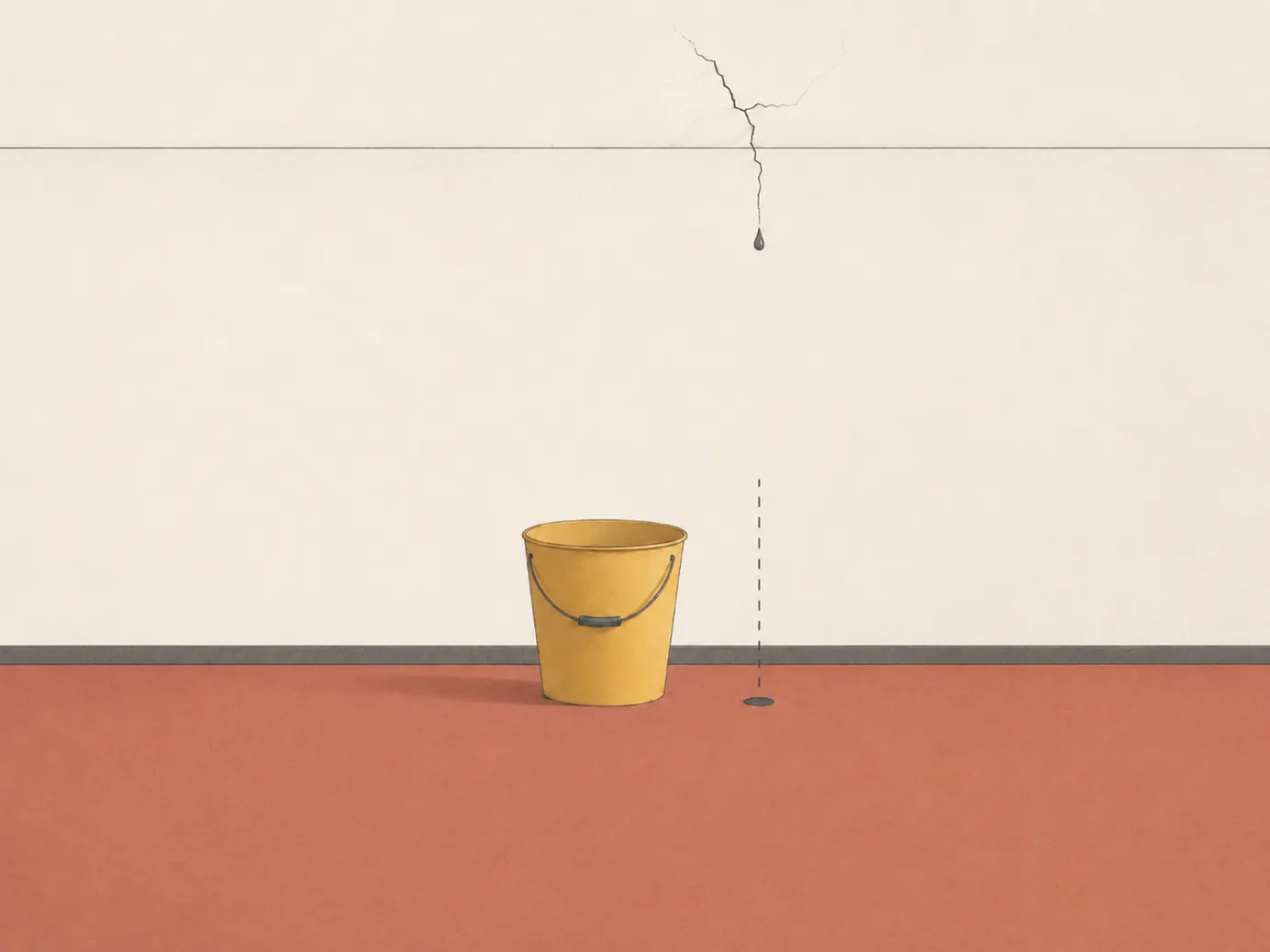
Because fixing the obvious thing is like patching a ceiling when the leak is coming from the foundations. The pressure keeps travelling through the rest of the structure, because the source was never quite where it appeared to be.
Start With Location
This is often where it helps to slow things down, at least temporarily. Yes, some decisions really can’t wait. You can’t hold off on the job change forever; the house still needs to be sold, money still needs attention, and that conversation cannot be put off any longer.
Taking action matters. But it works best when you really understand exactly what you’re dealing with.
If the problem really is the job, then changing it may help. If it’s really the money, then a clear financial plan may bring some relief. If it really is the house, then moving may open something up. If it really is the relationship, then an honest conversation may shift things.
But if your current job has become the place where identity, fatigue, money, status, and time have all gathered, then a new job may only move the pressure into a different waiting room.
If the house has become the place where memory, grief, belonging, and a sense of who you used to be are all sitting together, then a move may not resolve the question as cleanly as you hoped. If the tiredness runs deeper than exhaustion — if it’s wrapped around disappointment or the loss of a role you hadn't realised you were grieving — then rest may help your body without touching what’s driving it.
That’s why the first move is not always to listen to the loudest noise. In a jungle, the thing that catches you is rarely the loudest roar, but what’s moving silently just beneath your feet.
Sometimes the first move is to stop and look at the hidden information below the surface, because the real danger isn’t action. It’s Whack-A-Mole — fixing one thing, only to find the pressure pops up somewhere else — and then blaming yourself when it does. That’s when you tell yourself you were ungrateful, or indecisive, or impossible to satisfy, or just not very good at living the life you worked so hard to build.
Before you change the next thing, it helps to pause and ask a different question.
Where’s the pressure actually coming from, and is it really just one thing?
That reframing — from what should I fix to where this is actually coming from — is the real change worth making.
This is not a new problem. During World War II, statistician Abraham Wald looked at the bullet holes in planes returning from combat and told the military something that stopped them in their tracks: stop reinforcing where the damage shows.
The parts that were hit and still made it back had already proven they could survive the damage. It was the unmarked parts — the places where no returning plane showed a scratch — that were the real vulnerability. The planes that took hits there never came back to be counted.
The same logic applies here. The discomfort you feel is real. The job, the money, the house, the relationships, the tiredness. None of it is imaginary, but the place where the damage shows is not always the place that needs reinforcing.
Sometimes, it is simply the place that survived long enough for you to notice it.
Which is why the better question is not only “What should change?”
It is: Where is the pressure actually coming from?
Because when several parts of life start pressing on each other, clarity doesn't begin by fixing whatever is easiest to see.
It begins with knowing where you are most exposed, not just where life has started to hurt.