Why Midlife No Longer Has a Script


Summary: Longer lives have stretched the middle years into something far larger than the old life sequence was built to hold. The result is a structural gap.
In the summer of 2024, Simone Biles walked into the Bercy Arena in Paris and left with four Olympic medals: three golds and a silver. By any measure, it was one of the more remarkable sporting returns in recent memory.
Three years earlier, Biles had stepped back from several events at the Tokyo Games, citing her mental health and the “twisties” — a loss of air awareness that can make elite gymnastics dangerous in an instant.
At the time, the public reaction was polarised, as honest things often are. Some people understood immediately. Others simply couldn't reconcile her withdrawal with their idea of what an elite athlete was supposed to do.
For many people, Tokyo felt like the end of the Biles story. But what happened in Paris three years later was more interesting than a comeback.
Women’s gymnastics had long been organised around a brutally compressed idea of time. Peak early. Endure the system. Win young. Then disappear.
Biles was only 24 when she withdrew in Tokyo. She was 27 when she walked into the Bercy Arena. She didn't give the impression she was coming back to prove a point. Rather, she looked like someone with more autonomy, more authority, and a life less visibly owned by the system that had shaped her.
It was clear the old script no longer had a claim on her. In fact, Biles was demonstrating just how insignificant that script had become. One day, it simply stops fitting.
The Linear Illusion
Biles' story is more than an athletic triumph. It made visible what happens when we no longer accept the timeline built around us.
And that's the deeper point. A life script can work for us for decades before realising one day it has run out of steam. It can carry us through education, work, family, status, responsibility, goals, and achievement, and it can give shape to our lives for decades.
And then, one day, you find yourself in traffic or at the kitchen sink, and it dawns on you that the script has lost its authority.
Those realisations usually arrive slowly. More like air slowly leaving a tyre than a crash of lightning. You know the tyres are going soft, but since the car is still moving, you keep driving. As long as you can compensate, adjust, steer a little harder, and tell yourself it's all basically working, then what's the big deal?
But then, one day, you can no longer drive.
And that's usually how things fail – through a gradual loss of usefulness rather than a sudden collapse. You can still keep the household ticking over, turn up for work, and be a good partner. You can keep paying the bills and making plans, putting out the bins, and look as if you're managing it all. And for a long time, that's enough.
And then one day, standing at the kitchen sink or watering the lawns, something starts to feel less certain. You realise you no longer quite trust the structure that has been carrying you all these years.
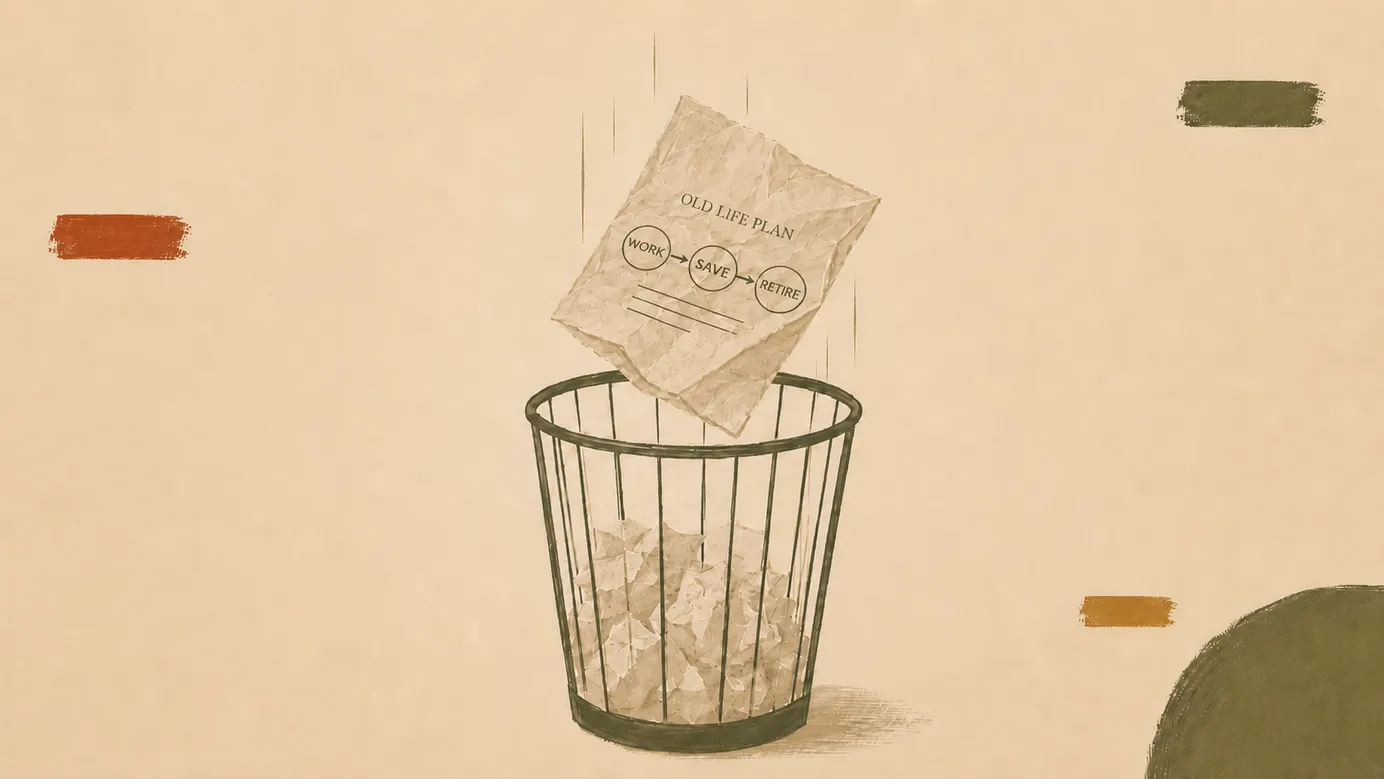
The old script still exists: learn, prove yourself, progress, consolidate, and eventually step back and retire.
But here's the problem. That doesn't explain the life you have in front of you. The script taught you that you might have a bit of spare time for downtime enjoyment at the end. And yet, here you are – with decades ahead of you, a long stretch of active life yet to be lived. In fact, life may be asking more of you than the old script ever prepared you to answer.
This is the stretch of life our culture still struggles to name. So we reach for the nearest available word and ask it to carry it more than it can, or should.
Midlife.
As if that is meant to explain it all away. As if the word arrives already packed with its own convenient explanations:
A wobble. A midpoint. A temporary crisis. A brief passage between youth and old age, a moment of reassessment before the same old sequence resumes.
And yet. That's the last thing millions of people are living with now.
What they are living is longer, messier, more active, and more exposed than that old convenient label allows. Lots of life yet to live, work to do, people to care for, and options to explore.
Sooner or later, that label starts to feel inadequate, even insulting. It reduces a vast, complicated stretch of life to a temporary wobble, as if millions of people have simply lost their nerve – on schedule.
Built For a Shorter Life
But that explanation only works if the old life script still has enough pressure in it to carry you forward.
It assumes a recognisable midpoint: a moment when we question everything, recover, and return to the life that was waiting for us on the other side.
For much of the twentieth century, the basic shape of life was easy to describe. First came education, then work, then progression, then consolidation, and finally retirement. Not everyone experienced that sequence equally or comfortably, but it was widely accepted and understood.
Before we were even aware of it, we'd adopted a kind of social grammar. You knew roughly where you were supposed to be, and by when. You knew what counted as progress and what institutions expected from you. And you knew, more or less, what came next.
But that is no longer the life many of us are living now.
We're living significantly longer than any previous generation. But the old sense of linearity has gone out the window. These days, careers stretch, stall, fragment, overlap, or are simply made obsolete. Families form later in life, then split, recombine, and carry obligations across much longer timeframes. Place is less fixed. Identity is less securely held by one role. And many people remain sharper, more capable, and more energetic for far longer than the old script ever allowed.
But the institutions around us – employers, pensions, housing, and even the stories we tell ourselves about what a successful life looks like – still behave as if everyone is following the same straight line.
Education. Work, Progress. Consolidation. Exit.
Almost nobody is.
And while much of the old surface has fallen away, the skeleton of that script remains. It still dictates what an education is supposed to look like, and when. And it still reaches into career trajectories and job titles, pension structures and mortgages, family expectations, and the way people explain their lives to themselves.
And one of the deepest assumptions in that old skeleton still survives today: that the middle of life is where everything is supposed to settle.
You've spent all these years building, earning, raising, accumulating, and preparing for an eventual exit. By now, the hard part is supposed to be behind you. You're meant to be on a glide path to the finish line: holding things together, managing what you've built, and slowly moving away from the centre of things.
But for many of us, that is not how this stretch of life now really behaves. The last thing it feels like is consolidation. It feels more like trying to find your way inside a life that refuses to follow the old sequence.
Questions that you once thought were settled return in different clothing: What kind of work is worth doing now? How much is enough? What kind of pace can I sustain? What happens when experience still matters, but the system no longer knows how to use it?
When these questions return, it rarely feels like the existential crisis we were told to expect. Neither does it feel like we've lost our way.
For most of us, it feels more grounded and ordinary than that. We are still capable, still engaged, still pursuing life with energy and vigour. That's not the problem. The real problem is that the old structure no longer tells us how to interpret the life ahead – especially when there may be so much more of it still to live.
And when a structure outlives its purpose, language is usually the next to fail.
The Problem With “Midlife”
That's the problem with “midlife.”
It's familiar enough for it to sound like an explanation, but vague enough to hide everything else that matters: restlessness, fatigue, ambition, doubt, boredom, grief, desire, or the sense that something really has changed.
All of that gets swept into the same convenient container.
For some people, the word still has some use. It acts as a signpost to a vaguely recognisable point in life, the moment when the old script starts to shed its authority and the familiar life instructions begin to lose their force.
But that's also incredibly misleading.
The problem is not just that this framing is inaccurate. It also trivialises something vast and complex. A convenient word constructed around a neat fictional endpoint cannot explain a twenty- or thirty-year stretch of active life ahead. It cannot contain work that still matters, families still changing shape, money that still needs to be managed, relationships and friendships that are ending and beginning, bodies that are still capable, and futures still very much wide open.
"Midlife" reduces a deep structural condition into a passing mood swing.
What many people experience in this stretch of life is far from that. What they discover is this: the sequence they've been following was built for very different life conditions. And they're no longer prepared to let it dictate the life they're actually living.
Yes, it is true that the old script had a certain clarity and simplicity to it. You climbed, stabilised, consolidated, then gradually withdrew. The trajectory was simple: upward linear progress followed by eventual exit.
But longer, less linear lives have made that shape much harder to trust. If you're in your late forties, fifties, or early sixties, you may still have twenty or thirty active years ahead.
And just as the years behind us didn't move neatly up or down, the decades ahead may not either. They may involve new work, new projects, changed roles, shifting responsibilities, new identities, and decisions that the old script treated as belonging to the margins of life.
It's insulting to treat that as just an epilogue. Too narrow-minded to reduce it to a once-in-a-lifetime reinvention. And far too consequential to dismiss this out of hand as a loss of nerve.
But it's not just midlife that fails. This also explains why so much familiar language starts to break down.
We toss around words like reinvention, starting over, and transition because they comfort us. They make uncertainty feel temporary. They all promise movement towards something clearer. They suggest that if you can just find the next right thing, the confusion will all magically resolve itself.
But each word smuggles in the wrong assumptions:
Reinvention implies replacement, as if it's your task to discard your old self and become someone new.
Starting over implies a clean slate, as if most of us can simply walk away from our responsibilities, relationships, money, history, and everything we've built.
Transition implies a corridor between two stable states. You enter the corridor from one room and leave through another. As if life were that simple.
At this stage of life, you probably have no need to become someone else. What you need is a sense of continuity through all that change. And that's a lot harder than reinvention, because it means keeping faith with what still matters to you, while loosening the old life structures that no longer fit.
That is a very different problem.
No One Built a Role for This
One reason this stretch of life is so challenging to describe is that our culture offers very few roles for people trying to carry continuity through change.
Many people are simply not winding down. And the whole idea of simply retreating from relevance or contribution not only feels premature. It's plainly absurd.
But neither are we beginning again in the way our culture likes to imagine. We're not blank slates. We already know the cost of effort and hard work. We're well aware that every decision has its trade-off. And we've been around long enough to know clean breaks are rarely clean.
But that also leaves us in an awkward place.
We're too experienced to be treated as beginners, too active to be treated as finished, too constrained by an old script to pretend everything is possible, and too capable to accept a convenient story of decline.
So we improvise.
You may have spent decades building judgement in a professional field that once knew how to recognise and reward it. Your experience still matters. You can still spot a bad idea, read a room, and make better decisions, because you've experienced enough of life to know things go wrong.
But the field around you may now reward a different kind of fluency. The person who knows the latest platform, talks confidently about AI workflows, and posts the right engagement signals on LinkedIn can look more contemporary than the person who actually knows where the real risks are buried.
That doesn't make you obsolete. But it can leave you in a strange place. You're still capable and still sharp, but no longer quite recognised by the system that once knew where to place you.
The same pattern can show up at home.
You may have spent years organising your life around children, parents, partnership, work, money, or some careful combination of all of them. For a long time, the structure was demanding, but at least it made sense. People needed you in ways you understood. There was a logic to the calendar, and your role was clear, even when it was exhausting.
But then the whole shape of it all changes. The children grow up, but don't simply disappear from your life. Parents start to need more from you. Your marriage might look stable, but it's been dented by years of compromise, exhaustion, or deferred conversations. The household might still be ticking over, but it's gradually becoming harder to explain why everything is organised the way it is.
There's no sense that your life is falling apart, as the "midlife" pundits would have you believe. But the role which once gave all that effort in your life a clear direction has started to blur.
So you improvise. You keep parts of the old role, discard others, borrow from elsewhere, and make adjustments no one prepared you for. You might stay involved in work, but refuse to organise your whole identity around the job. Or you may remain central to the family, but stop being available for every demand.
This is what usually happens when the available roles are too crude for the lives we are actually living.
Advice Has Its Limits
Because society has very few role models for this stretch of life, it tends to offer something else: advice.
And there's no shortage of it. Change career. Retrain. Protect your pension. Improve your sleep. Manage your stress. Support your parents. Reconnect with your partner. Find your purpose. Make a plan. Be brave. Be grateful. Be positive.
Some of this advice may be useful in the moment, and much of it is certainly well-intentioned. But advice often assumes a single problem with a fixable answer. What most of us are actually dealing with is not just one thing going wrong. It's everything slowly coming out of alignment at once.
And most of that advice treats the problem as if it's YOU. You haven't spent enough time reflecting. You haven't thought this through. There's a reason you feel lost. You might be lacking confidence. You need to read this book, go to that retreat, work with this coach, or invest in this course to unlock the next right answer.
Our deeper issue isn't a lack of advice. It's that this advice treats this stretch of life as a moment to muddle through.
That's the insult. For most of us, it's never just a "moment." It's the rest of our lives.
Living a long, non-linear life doesn't just produce one question that can be answered once. The same questions keep returning, each time in different combinations.
Work changes while your health changes. Your parents need more from you at the same time your children need something different. Money becomes tighter, just as your relationship starts to feel under strain. Technology is constantly rewriting the value of what you know in the very moment you're trying to use it.
There's no way a one-time reset can hold all of that. It's both impractical and naive.
So no. The last thing we need now is another burst of inspiration.
That's why this phase can feel so tiring, even when nothing is obviously wrong. Each new decision requires a fresh act of interpretation, because the combinations keep changing. And every time they do, the last answer stops working. And you've now gone full circle, starting all over again.
Try finding advice for a "midpoint" in that.
But in a longer, nonlinear life, facing different combinations of the same pressures isn't some kind of midlife failure. It's actually part of the condition.
The real failure is expecting ourselves to work it out on our own, again and again – or sending people off in search of generic advice for a fictional midpoint that can, in reality, appear repeatedly at any stage of life.
The Decisions Get Heavier
It's not just the pressures that change. Our decisions can get heavier too.
Earlier in life, most of our life choices come with a safety net. You can move, retrain, change fields, leave, rebuild, and try again. Of course, that doesn't come without cost, but you've enough runway – financial and otherwise – to absorb those consequences.
Later in life, that stops being true.
A choice about work is never just about work. It affects your income, energy, mental health, relationships, where you live, and how you see yourself. A decision about where to live is never just about place. It might involve ageing parents, established friendships, grown children with their own children, the cost of housing, who you'd be leaving behind, and who you'd be moving closer to.
Each decision leaves larger ripples.
All of that doesn't necessarily make you more afraid. Actually, it often forces you to be more precise about things. You become far less willing to perform enthusiasm for roles that suck more out of you than you can give. You reach a point where, weighed against everything else, status simply stops mattering to you. And you're more alert to the hidden information beneath all the obvious questions in life.
"What can I do next?" is no longer your question. "What can I live with over time?" gradually takes its place.
To your friends, colleagues, and family, that might look like hesitation. And yes, deep down it can often feel that way, too. But actually, most of the time it's your judgement kicking in. If you're pausing, it's because the decision is no longer simple. You're holding far more variables in your head than the old script ever had to recognise.
Don't let anyone take that away from you.
The Real Question
The old life script rewarded forward motion. That made sense when life was shorter, more linear, and more predictable.
Longer, nonlinear lives ask for something much harder: the ability to keep adjusting without having to start all over from scratch every time.
And once you see that, you can see why midlife has been carrying so much crap for so long.
The real question is no longer what's wrong with you. The real question is why "midlife" has been allowed to explain away something this large for so long, unchecked: a long, active, complicated stretch of life that the old script was never engineered to hold.
That question matters because it removes a great deal of unnecessary pressure and self-blame. If the old script no longer works, that's not a sign that something's wrong with you. It's a sign that you're trying to live a longer, more complex life with tools built for a simpler, more predictable one. That's also liberating.
The middle of life hasn't disappeared. But it no longer behaves like a "middle."
In an older, more predictable life sequence, there was a middle you could point to. The line made sense. Each life stage had a recognisable order. What came after the midpoint was supposed to be consolidation, withdrawal, and eventual exit.
But in a longer, less linear life, that old midpoint immediately loses its authority. The same questions arrive more than once. The pressures return in different combinations. Work, family, money, health, identity, and responsibility never stay neatly in their assigned places.
What we've been taught to expect at "midlife" isn't any failure that's unique to the middle years. It's what happens whenever the script stops working, and life asks you to adjust.
That question no longer has any right of claim to "midlife."
It belongs to life. Every point in life.
Simone Biles made that visible at 27, in a sport that once expected its greatest athletes to peak early, win young, and then disappear. The rest of us are still encountering the same problem, less publicly, across decades of change.
The failure was never ours to own. The script simply ran out of life while life was still asking years from us.