Longevity Deserves More Than Retirement

Summary: Retirement was built as a concept for a shorter, more predictable life. But longer, less linear lives now ask for far more than one old idea was ever designed to carry.
In 1859, Charles Darwin published a book that reordered the way human beings understood themselves. He was fifty years old.
When On the Origin of the Species was published, it changed how people thought about life. And, by any reasonable measure, the work was done.
By every measure, the conditions for Darwin to stop were ideal. He had retreated to Down House in Kent, at the end of a quiet lane chosen partly for its distance from London and the demands of public life. His health had been difficult for decades, he rarely travelled, and he had no university post, no laboratory, and no institutional obligations.
And yet he didn’t stop.
Over the next twenty-three years, he published books on orchids, climbing plants, the emotional lives of animals, coral reefs, and the movement of plants in response to light. His last major work, published the year before he died at seventy-three, was a detailed study of earthworms and their largely invisible role in shaping soil over geological time. He had been thinking about earthworms, on and off, since the 1830s.
Back then, there was no talk of a “second act,” or “reinvention.” He simply continued, in a lower register and at a different pace, without the pressure of the great argument still waiting to be made.
“Retired” didn’t fit. “Still working” didn’t quite capture it either. He was something the available language hadn’t yet learned to describe: a person who had finished a piece of work that had defined one chapter of his life and kept going anyway.
Clean Endings
Granted, Darwin’s case was unusual for its time, but the question it leaves for all of us is not. What happens when you reach the finish line, but don’t feel finished? Retirement was supposed to answer that.
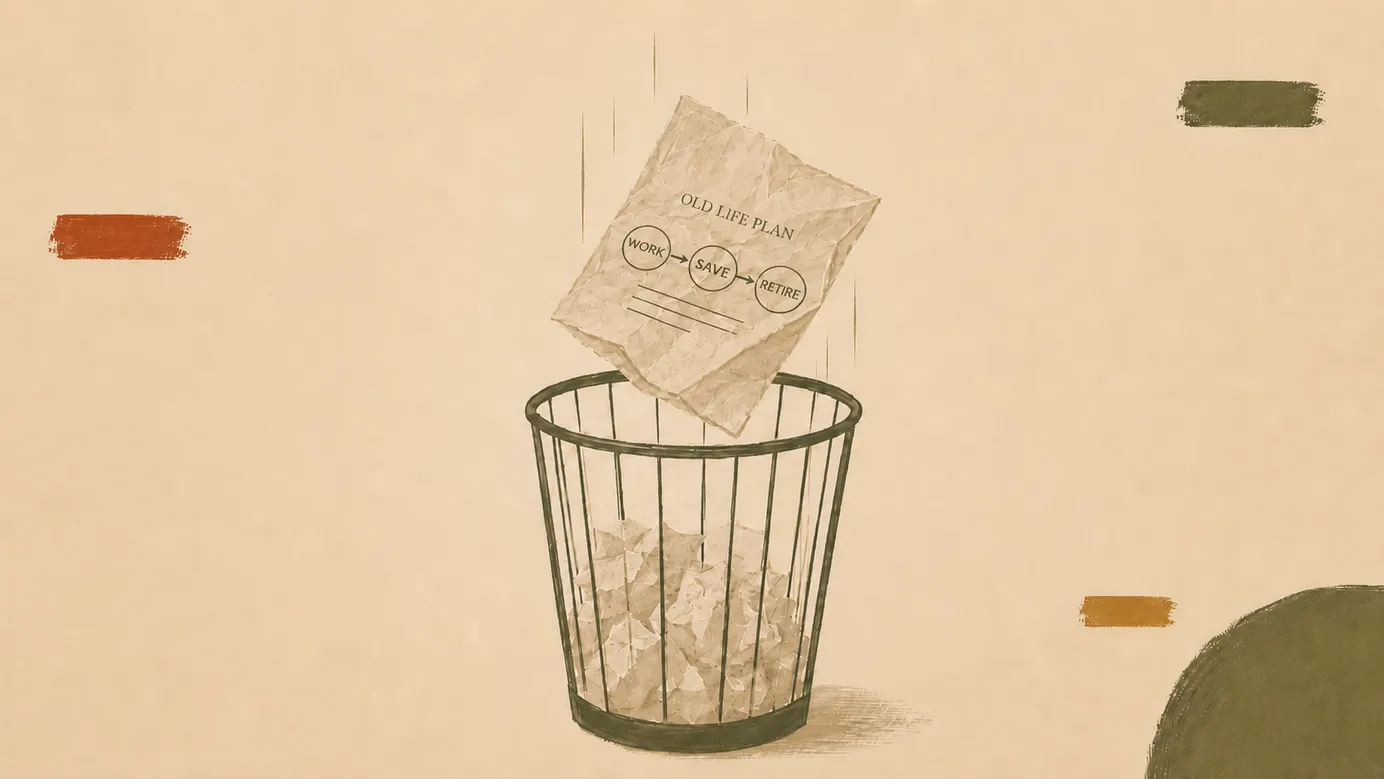
For a long time, the deal was quite simple. You worked, paid in, and built up your pension as best you could. You moved through the stages laid out before you: education, work, progression, responsibility, and accumulation. And at some point, if things went reasonably well, you reached the finish line. You might not end up rich. But life would make sense, the pressure would have lifted, and you’d no longer need to question the path ahead.
That was the deal.
Work would come to an end, or at least release its grip. Its demands would fall away, and time would open for slower mornings, longer conversations, postponed interests, travel, family, and rest. After decades of being useful to other people’s agendas, life would become yours again.
For some people, that promise still holds. And if you’re one of them, I’m sure retirement arrives for you as genuine relief: hard-earned, long-awaited, and deeply deserved.
But for many, that promise has started to fray.
In a recent Standard Life / Ipsos survey, one in six retirees had either returned to work or were considering doing so. Three in ten said their standard of living was worse than before they retired. One in five said they had not realised how much money they would need.
In the US, the picture is similar. One recent survey found that one in six retirees were considering returning to work, while another found that 7% had already done so in the past six months.
Those numbers don’t exactly prove that retirement has failed. But they do point to a deeper problem. They suggest that the old promise is no longer landing as it once did. In the UK, research at King’s College using long-run panel data found that around one in four retirees had returned to work within five years of leaving.
And while more recent surveys have put the figure lower, the direction remains consistent: more people moving back toward work, more citing financial pressure as the reason, and more discovering that the promised retirement life is harder to sustain than the original plan suggested.
The same pattern is evident in the US, where the proportion of people over 65 who are still working has roughly doubled over the past 30 years.
While that may not be a crisis, it’s a signal. The retirement model may not be collapsing, but millions are questioning whether the promise still holds.
Yes, the finish line still exists. So does the word. The pension statements still arrive, and the financial calculators still ask when you intend to stop. And yet, life beyond the finish line, the one you spent decades working toward, no longer feels as simple as the story once suggested.
It’s not just the data that is forcing us to ask the question here. It’s the structure of life itself. It’s no longer simply a question of: can I afford to retire? Today, the more pressing question is this:
What exactly is retirement supposed to organise now?
Built for a Different Life
To understand why that question is so hard to answer, it helps to understand what retirement was originally meant to do.
Retirement did not begin as a dream of fulfilment, but as a form of protection. And, for much of the twentieth century, that made sense. Work was often more physically demanding, life was shorter, and health decline tended to arrive earlier.
Back then, the post-work years were never imagined as a long, open stretch of life to be designed, shaped, funded, and filled. They were simply a much shorter period of relief near the end of a working life that had followed a broadly predictable path. You worked for as long as your body, your employer, and the system allowed. And then you stepped back.
In that world, retirement had a clear purpose. Not only did it protect people from exhaustion, but it also gave dignity to those who could no longer keep going. It offered a social answer to a practical question: what should happen when working life had reached its natural limit?
But history knows things don’t stay that simple.
What began as social protection slowly became a default life stage. At some point, someone came along and painted a finish line. By the time the paint had dried, it had become a cultural expectation.
And once that line became visible, other structures began to be erected around it: careers, pensions, savings, family plans, and a sense of who you were and what you stood for.
All those structures made complete sense for a world where working lives were shorter, bodies wore out earlier, and the post-work years were never expected to last very long. And they were solid. But they were built for a human timetable that no longer exists. And that is where the trouble begins.
The old model assumed a broadly linear life: education first, then career, then retirement. Each stage had its place, and each stage passed the baton cleanly to the next.
But longer, less linear lives have stretched that sequence to the point of snapping. Today, many people are arriving at the traditional edges of retirement with years, sometimes decades, of capability ahead of them. And their judgement, experience, relationships, skills, attention, and usefulness are very much intact.
Life today is no longer the straight line everyone assumed. There are gaps, overlaps, second starts, and unplanned chapters. Careers are interrupted, and each reinvention forces a renegotiation of who we are.
And this new nonlinearity is here to stay. New evidence in the UK shows that Gen Z are already reaching adult milestones later than previous generations, and the path from education to work has become more fragmented and less predictable. You can’t bury your head in the sand on this one. Nonlinearity has arrived, whether we choose it or not.
And yet, the old finish line remains painted in the same place, still there but without a fresh coat. But someone else has come along and painted another one further down, and then another. And while policy, pensions, employers, and personal circumstances might be pushing it further down the road, the deeper assumption remains intact: that there must be a clean line separating contribution and withdrawal – capability on the one hand, retirement on the other.
More Time, No Script
That assumption held, more or less, when people lived shorter lives, and for as long as it served the business model. But then, the years kept coming, and few people had quite planned for what to do with them. So instead of asking what those years might hold, we did what institutions tend to do when something doesn’t fit the old model.
We treated longevity as a problem. Rising pension costs. Ageing populations. Pressure on healthcare systems. Retirement savings stretched across more years than they were designed to cover.
The uncomfortable truth is this: longer life itself is not the failure. The failure lies with the institutions built around the old model, which lacked either the imagination, the incentive, or the political will to redesign it when the conditions changed.
For decades, retirement served as a kind of cultural shorthand, conveniently answering a set of questions in advance. What happens after work? What replaces career? What shape does later life take? And the answer was broadly understood. You stopped and rested. You withdrew from the main highway of working life and entered a quieter road, a phase organised around leisure and reduced responsibility.
For some, that remains the right answer. If that’s the life you want, whether you feel it’s earned, deserved, or simply necessary, there’s absolutely nothing wrong with choosing the quieter road.
But that road no longer suits everyone.
Many people are now entering their 50s, 60s, and even 70s with years of experience, judgement, and usefulness still very much intact, yet with no clear script for what to do with any of it. People who once occupied clear professional roles can suddenly find themselves in a no man’s land: “too old” for the pace and assumptions of some workplaces, too capable to feel finished, or “too experienced” to disappear comfortably into the background.
This is why the entire retirement lexicon increasingly feels strained. It’s no longer simply about “rest.” The issue is that “rest” became the default answer to a much wider set of questions – questions about identity, structure, usefulness, and what comes next.
Retirement was always supposed to mark the end of capability. For many people today, it no longer does. Millions of people are not post-capability. They’re post-script.
Too Much to Carry
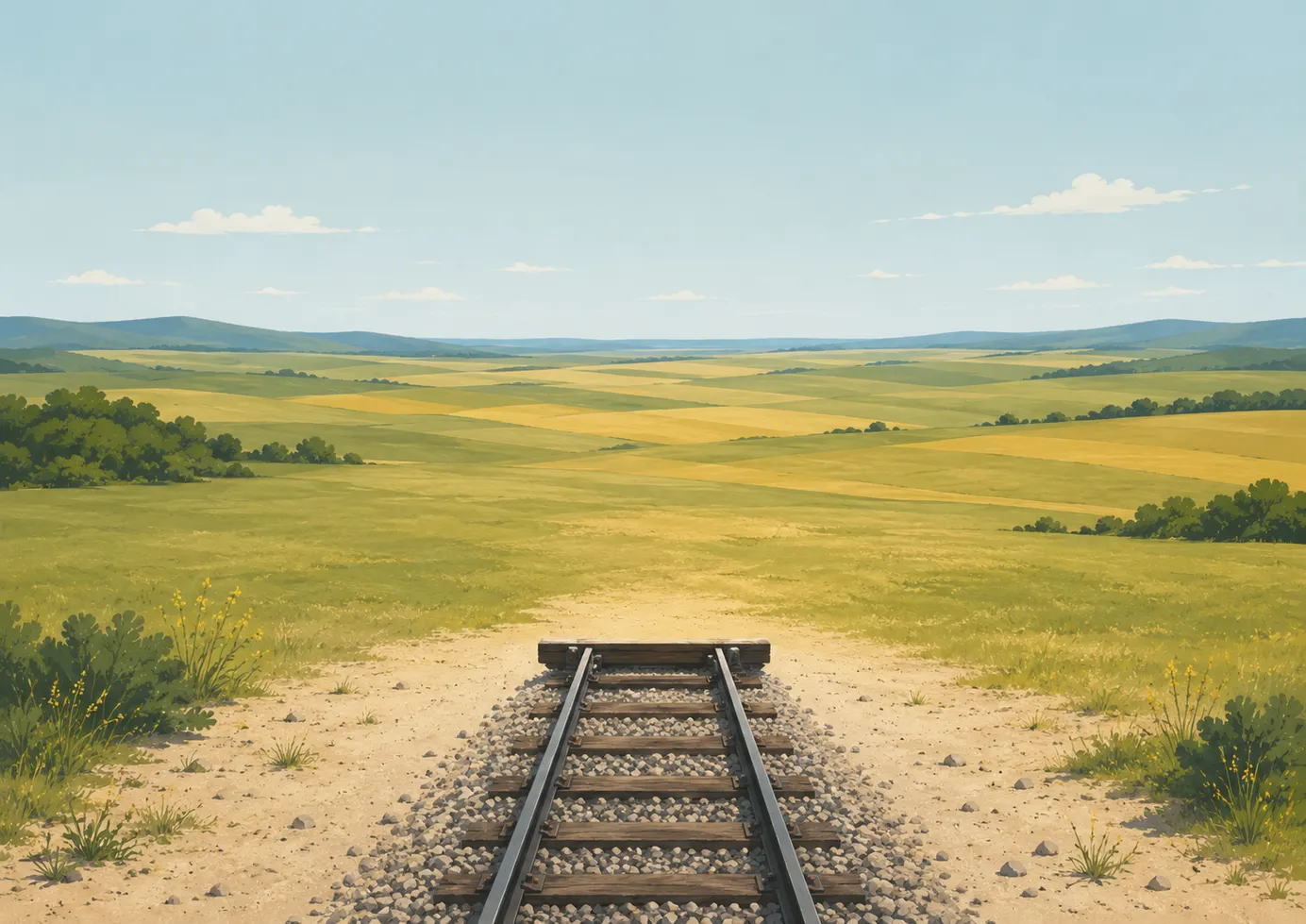
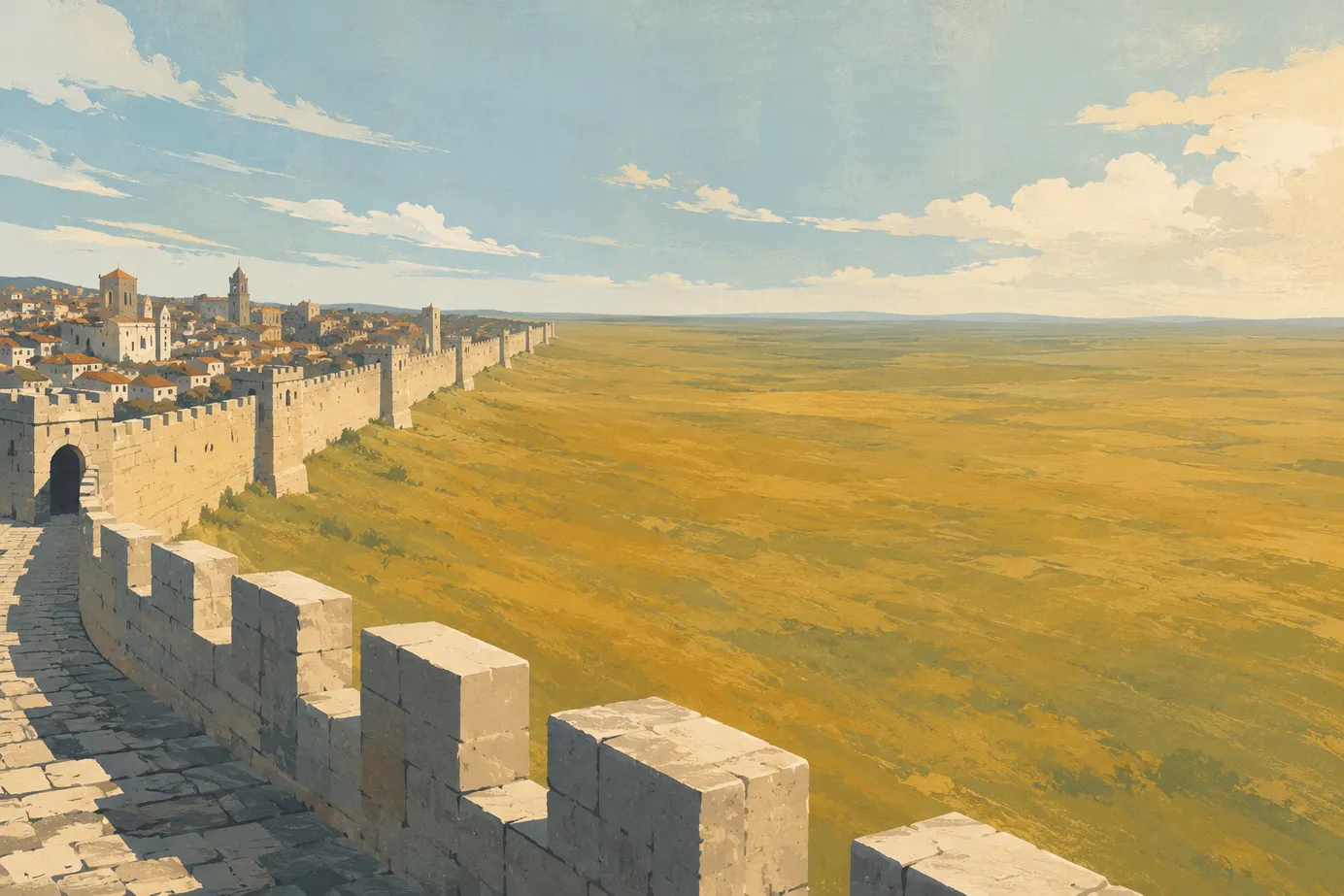
Being post-script means you step beyond the old finish line and find yourself in a vast, open prairie. There are no signposts here. There are no paths and no clear sense of what comes next.
This place is what society calls “retirement.” But retirement was never meant for this kind of terrain. It was meant for something far simpler: a shorter period of withdrawal after the main work of life was done.
Now the prairie has expanded. More people are entering it, but with less intention of simply crossing it and then disappearing. And they’re now asking a different set of questions that were never raised before.
How much money is enough if life may last another thirty years?
What fills the days when the diary is suddenly empty?
What happens if health, family, markets, or care needs change?
And beneath all of that:
What do I stand for now?
The old retirement model assumed you would have a steady career, save enough along the way, and stay reasonably healthy. The institutions built around it assumed your life would follow a middle path: the average career, the average lifespan, the average market return, and the average amount of disruption, which is to say, hopefully not very much."
They assumed that if they planned for the majority, the entire structure would remain intact.
But life rarely behaves to suit the actuaries and pension funds. A bad year in the markets early in retirement can do more damage than the same bad year later, because you’re drawing down at the same time the value is falling. A partner's illness can rewrite the plan overnight. And work doesn't always end when you're ready for it to or stop when you expected it would.
Traditional retirement planning has always focused on whether the money will last. And while that question still matters, an even larger one is looming alongside it: whether the structure of this “chapter” of life will continue to hold.
For more people out there on the open prairie of retirement, it’s no longer a question of simply replacing a salary. Now, retirement is being asked to replace rhythm, role, identity, social contact, usefulness, purpose, certainty, and direction, and all of this across a far greater and less predictable stretch of life than anyone had previously imagined.
That is why the conversations about retirement often feel strained. They talk about freedom, but you can sense the anxiety below the surface. They dream of finally stopping but feel a sense of drift once the old professional structure has fallen away.
If you’re honest with yourself, the retirement you imagined was never just about the money. It was more about the promise of a certain life once you crossed the threshold. Today, that promise feels thinner for many people, simply because a single word is being asked to carry far more of your life than it was ever meant to hold.
More Than Two States
Part of the reason retirement feels so strained is this: it only ever gave you two options. You’re either working or retired.
One state has a name, a salary, a status, and a reason to get up in the morning. The other is supposed to be restful, a period of leisure, privacy, and a gradual withdrawal from the things that once defined you. For a shorter, more predictable life, that division may have been tolerable. For today’s longer, nonlinear one, it’s increasingly crude – and often absurd.
Many people approaching retirement are simply done with the old version of work and everything it carried with it: the intensity, the politics, the hierarchy, the endless consumption of time and energy, the relentless need to keep proving yourself to people who may never have deserved that much of you in the first place.
But that’s a different argument altogether. And it doesn’t mean you need to or want to simply disappear. You might still welcome the old rhythm, but without the pressure. And you may still want to matter — a lot. But just not at that cost.
And this is where “retirement,” both as a word and a structure, begins to collapse. Once we see it for what it is, it was never more than a very crude binary.
What we need instead is a spectrum of contribution. But let’s handle that term carefully. That doesn’t mean everyone should stay in full-time work for longer. Neither does it mean turning later life into one vast engine shed of productivity. Nor does it mean we turn a blind eye to the signals – real fatigue, illness, necessity, or just the plain right to stop.
A spectrum simply means that usefulness can take more than one form and doesn't have to be continuous to count. You might mentor, care, teach, or show up for your community in ways that a job title could never quite capture. But that's just the start. You might start something new. Build a business. Become a creator. Combine skills and experience in ways that didn't exist as viable options even a decade ago. The tools and resources available today make combinations that would once have seemed inconceivable not just possible, but genuinely within reach.
Part of what makes a spectrum powerful is that it's completely aligned with both longevity and nonlinear living: it accommodates change over time. Withdrawal doesn't have to be an event — a line you cross once and never return from. It becomes a mode. Something you can move into and out of as circumstances, energy, and inclination shift. Which means it remains a genuine option, rather than the only story on offer.
New Patterns Emerging
For far too long, “full withdrawal” has been the only story on offer. But slowly and without much fanfare, people have started writing different stories. They may not have language for it, and they may continue to call it “retirement,” “semi-retirement,” “consulting,” “helping out,” “doing a few days,” or “just seeing what comes up.”
But the pattern is clear by now. People are starting businesses, creating content, and building new income streams. Some are taking on small pieces of work. Some are moving in and out of paid roles. Some are changing where they live because the old place no longer fits the life they are trying to build. Others are learning how to reconstruct their week after the old professional calendar has gone.
What used to look like “semi-retirement” may now be becoming something mainstream and far larger: people assembling lives that the old retirement lexicon simply never anticipated.
People are now “retiring” differently. They’re recomposing elements of their life across several domains at once. And while money is part of that recomposition, it’s no longer the whole story. Yes, the numbers matter: pension income, savings, housing costs, inflation, care costs, and state support all influence what is possible.
But later-life income is no longer just about reaching a target number. It’s also about the room to manoeuvre and maintain optionality: the ability to keep your options open, to move, to adapt, to change course without the whole plan collapsing around you. Because optionality isn’t just a financial concept. Even a small amount of earned income changes the emotional meaning of the pension pot sitting alongside it. It’s proof you still have something to offer and that you’re not wholly dependent on a single fragile plan. It also ensures that the spectrum of contributions remains open to you.
That is the real change in thinking. The old model asked for a single answer: work, then retire. But in longer, nonlinear lives, that single answer is no longer workable. What’s emerging instead are combinations: personal, flexible, fluid, and aligned with your changing circumstances.
That’s why the next question is not only whether you have enough money, but whether the money gives you room to move. That in turn leads to an even greater, more personal question that no financial calculator has ever been able to answer: what kind of life are you actually trying to build out there on the open prairie?
A Longer Life Needs a Longer Role
A longer life deserves more than retirement. But that doesn’t mean one job forever. Nor does it mean every additional year beyond the finish line has to be justified by output.
It means something more important than simply extending the old job. It means a life where you can still contribute and matter, across whatever comes next. That might mean building something small, joining a young company, writing in public, teaching what you know, backing a project, making a digital product, creating a small business, mentoring, caring for family, or simply becoming useful in a place that didn’t exist when your career began.
The point is not that everyone should keep contributing in the same way or at the same intensity. Some roles or projects may last for years. Others may be a temporary project, a small experiment, a piece of work, a period of care, or something built before moving on. Some people will need to stop. Others will want to. All at different times. And everything in between – periodic rest, privacy, recovery, and temporary or permanent time out – has to remain legitimate.
Withdrawal was never the real problem. But making it the only acceptable story was. Once retirement becomes the only story society tells about life beyond work, everything other form of contribution starts to disappear from view.
That could be the person who left their job last year and is now holding the family together. Or the person who tinkered with something small on their kitchen table and has now launched something. It could be the person learning a new skill, creating something, earning a little on the side, or simply showing up for people who need them. None of that can be described by the old lexicon. But that doesn’t mean its absence is nothing.
Back in 1859, Darwin never called what he did a “second act.” He didn’t brand it as a “portfolio career” or a “reinvention.” He never referred to himself as a “late bloomer.” He simply continued — on his own terms and at his own pace. It was the work itself that kept him anchored. He had simply concluded one chapter of his life, and the rest remained to be written.
That is what a longer life deserves. No labels. No finish lines. Just room and flexibility to keep going on your own terms, and at your own pace.
Longevity has given many people more life than the retirement model knows how to organise. The media and literature give us countless inspirational examples of people doing exactly that. But then again, inspiration was never really the point.
The real point is structure. What comes after the finish line needs to be designed and made to last – not some viewpoint over an open prairie that you admire from a distance, but a life you actually walk out into, with agency.
Your next question is not simply how to fund the years ahead.
It’s how to truly live them.