Your Financial Plan May No Longer Reflect Your Life


Summary: Retirement planning used to be organised around an ending: earn, save, retire, pass on what remains. But longer, less linear lives are calling the entire model into question.
In the 2015 film The Intern, Ben Whittaker seems to have done everything right.
He’s built a solid, well-paying career he was good at, saved carefully along the way, and is now retired – on schedule, ready to put his working life behind him. The way it’s meant to be.
But just as Ben starts to put into practice the retirement plans he’d made with his wife, she dies. And so do their plans.
But even before he lost her, Ben had already started to notice that the retirement he’d planned for wasn’t sitting quite right. He’d already tested out a few things: travel, golf, and tai chi in the park with other men his age. None of it seemed to stick.
What he hadn’t anticipated was how much of himself had been organised around work and career. Once the work was gone, time was abundant, but he just didn’t know what to do with it.
So, at 70, Whittaker applies for a senior intern position at a fashion startup run by a woman 40 years his junior – not for the money, but a yearning for some of the old structure.
In case you’re thinking this is a story about retirement not working, it isn’t. The real issue is that we build our financial lives around a beginning, middle and an end, and then discover we have nothing to say once we cross the finish line.
The Unfinished Tab
Sound familiar?
You’re at that stage of life when you’re feeling you’ve made all the sensible moves: saved when you could, paid down debt, made regular contributions to the pension pot, built up some security, accumulated some assets – doing all the responsible things slowly but surely over the years.
And yet somehow the subject of money still doesn’t have a ring of closure to it. You might not be lying awake at night doing crisis calculations, but there’s this sense that your financial chapter is still open – like a browser tab you keep open for weeks on end and can’t bring yourself to close.
Perhaps you assumed that reaching a financial accumulation threshold would eventually produce something tangible. There’s a certain solidity that comes with closing a book or crossing a finish line, and closing the financial chapter of your life feels the same. A box you can finally tick.
Except that the box remains unticked.
And the strange thing is, you can’t entirely explain why. Most likely, your plan worked, or near enough.
So, what’s missing?
The Old Financial Story
There's a reason the financial plan felt like it should work; for most of the twentieth century, at least, it was built on a story that made complete sense.
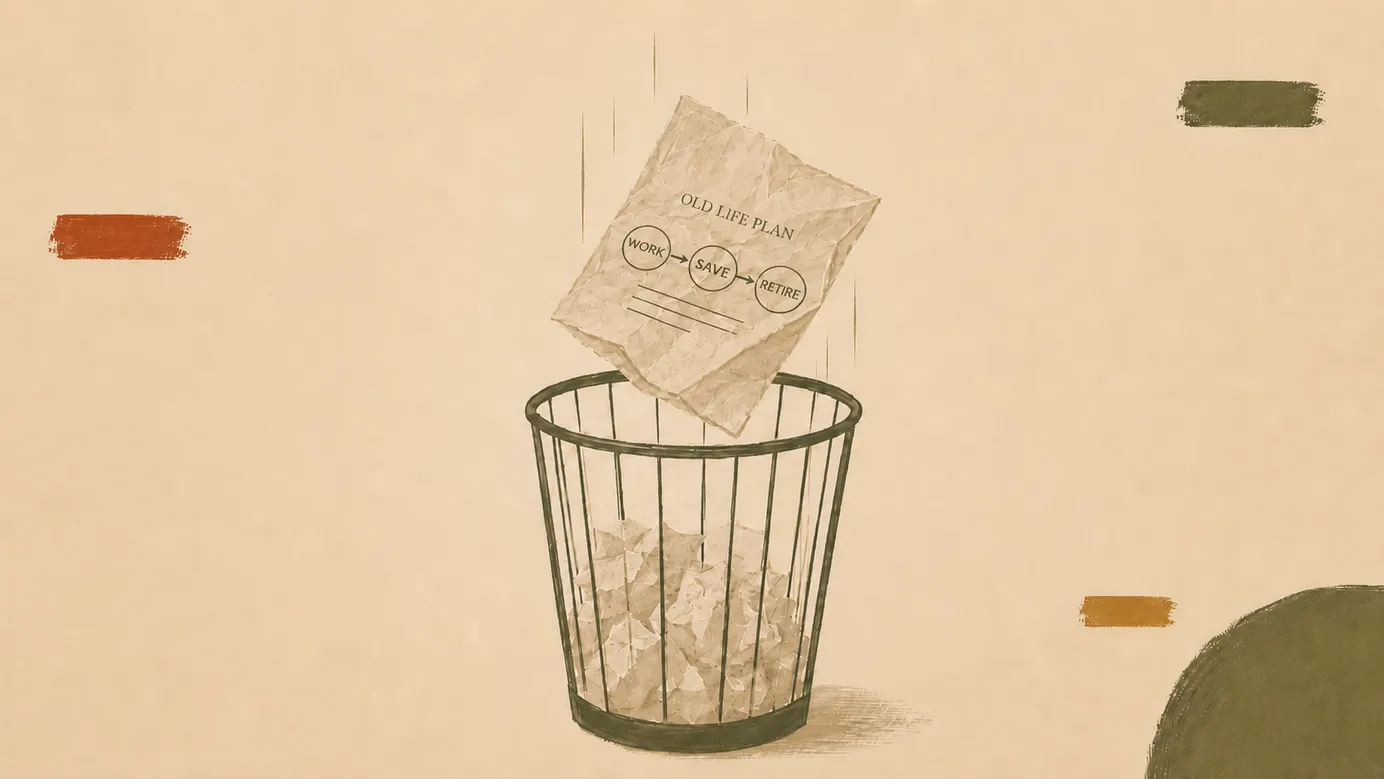
That story went something like this. You got an education, built a career, and increased your earnings along the way. Accumulation was the name of the game — pension contributions, property, savings set aside for later. Then you retired, drawing down what you'd built over a lifetime. This final phase of your life was about gradually slowing down and eventually passing on what was left to the people you loved.
Each stage of life had its own financial job to do. We knew the student debt wouldn't last forever, and the mortgage would eventually be paid off. Meanwhile, the pension was ticking away quietly in the background. Retirement was the ultimate destination, and whatever you left behind was considered the epilogue.
The financial sequence was linear because it reflected life, which was linear as well. You moved through the stages in order, with each stage making sense of the others.
But that life story did something else too, something which is far less often acknowledged these days.
It did emotional work.
Knowing where you were in the sequence gave you a framework for how to feel about money at any given moment. Being behind where you wanted to be was uncomfortable, but it made sense. Being ahead of schedule felt like progress.
You were moving toward the finishing line – that distant beacon on the horizon, constantly present, organising everything around it, giving the whole effort its scaffolding.
The financial plan wasn't just a financial instrument. It was a way of knowing where you were supposed to be in life, and in what order.
Moveable Finish Lines
But here's the problem with that story. It's not about whether your financial plan is structurally sound. It’s that the shape of life itself has fundamentally changed.
One of the common themes here at The IC is that people are living longer – not just a few years longer, but decades longer, in ways that previous generations had no life template for. Careers that were supposed to taper are doing anything but. People are unretiring, starting businesses in their fifties, becoming creators, moving country, re-partnering, all while caring for parents and still supporting children.
And here's what that means in practice: what was once considered the third and final phase of life is no longer one long, final, homogenous chapter. It has broken down into so many nonlinear pieces that for many people, it's become almost indistinguishable from the middle — just as unpredictable, just as full of false starts, pivots, and new beginnings.
The stages of life that were supposed to follow each other in order are arriving out of sequence, overlapping, or not arriving at all. And so, the old question — when can I stop? — no longer captures what’s really going on.
Because stopping may no longer be the point. And while for some it still is, for many others the better question isn’t when they get off the bus at the terminus. It’s how they keep enjoying the ride.
That's a fundamentally different ask, and one that the traditional financial plan was never designed to answer, because the old plan was built around a fixed destination.
The problem now is that the destination is no longer fixed. The moment you throw longer, nonlinear lives into the mix, any plan built around the idea of a fixed destination simply can’t keep track of a life that’s constantly changing direction. And given the stakes, that’s an increasingly dangerous assumption.
More Than a Number
This is where the whole money question gets personal, because nobody says the quiet bit out loud: money is no longer only about retirement income, and it stopped being only about that some time ago.
Yet the entire money infrastructure—the planning frameworks, the projections, the pension forecasts, the net worth calculations—still largely behaves as though it were.
At this stage of life, you’ve probably given money plenty of attention. The problem is that the traditional financial plan isn’t giving it nearly enough credit, because it’s far more complicated than simply treating it as a finish line.
First of all, money is tied to time, to whether you can afford to slow down, stop, or change direction without your whole life structure collapsing. It's also tied to freedom, not in an abstract sense, but in the practical, day-to-day sense of having options that remain open.
Then there’s care: who you might need to support, who might need to support you, and what that will cost in ways nobody can fully predict. It's tied to housing, which is simultaneously a home, an asset, a source of anxiety, and a decision that keeps deferring itself. It's tied to family, to contribution, to identity, to health, to the choices you want to still be able to make ten years from now.
That's a lot for a pension forecast to hold.
And yet that's exactly the position you might find yourself in. Financially competent, ticking most of the right boxes, and yet still uneasy, still carrying that open tab, still unable to quite close the browser.
But that unease isn't a sign that you've planned poorly. It's more likely a sign that the plan was designed around a simpler, more linear life than the one you're actually living.
And that plan was built for a different version of life.
A Case In Point: Estate Planning
And nowhere is this more visible than in the way we think about inheritance and estate planning as a window into how thoroughly the old life sequence has come apart.
The traditional view of estate planning followed the same arc we described earlier: accumulate during your working years, retire, slow down, and eventually pass on whatever remained to the people you loved. The estate was the epilogue, or what was left after the main life story had concluded.
Here's the problem: that assumed the main story had a conclusion. For many people now, it doesn't — or at least not a tidy one. The ending keeps revising itself to the point where it often looks more like a middle than an end.
You might originally have expected to be winding down by now, but instead, you still have children living with you, unable to get onto the property ladder, navigating their own nonlinear careers, or simply requiring more grounding from life than they might have hoped. You may still be helping ageing parents or navigating a new partnership that reshapes every assumption about who the estate is for. And the family home may need to fund care, a relocation, or an entirely new chapter long before it was ever supposed to be passed on.
But there's something else the old model never accounted for. All that extra time that longevity has handed you doesn't only appear at the end. It shows up in the middle too — as a sabbatical, a new venture, a chapter that needed funding long before any inheritance conversation was supposed to begin.
The estate is no longer simply what remains after life is done. For many people, it has become part of the working architecture of a life still very much in progress — something to be drawn on, restructured, reconsidered, rather than preserved intact for an ending that keeps not quite arriving.
The question of inheritance has changed because the fundamental shape of life has changed.
Enough – For What?
So, if the finish line is no longer the right organising principle for financial planning, what replaces it? A bigger number or a more sophisticated forecast? A revised retirement date?
I would argue it’s none of these. At the heart of the old planning framework was the following question: how much is enough?
But that was really the finish-line question in disguise. It assumed there's a number and that reaching it resolved something.
The better question is: enough for what?
Enough to keep moving on your own terms. Enough to pause when you need to without hollowing out your own position. Enough to be able to leave a situation, a place, or an arrangement that no longer works. Enough to adapt when the life you planned for turns out not to be the life you’re living. Enough to fund the next chapter, whatever that turns out to be. Enough that you're not trapped — financially, practically, emotionally — by one version of the future that may never arrive.
That's what financial optionality actually means in a longer, less linear life. No longer a question of “wealth” in the abstract, or “security” as a fixed state, but room to manoeuvre and the capacity to keep responding to a life that keeps changing.
In this new framing, money is no longer the destination, but the oil that keeps the machinery of life moving without friction.
Time to Rethink “The Plan”
Remember Ben Whittaker? After a lifetime of building a career and saving carefully, the financial chapter of his life closed exactly as it was supposed to. His plan had worked.
He wasn't foolish, and he’d made good decisions along the way. But the finish line, it turned out, was just a door into a room that nobody had thought to furnish. So he went back to work, but not because the money demanded it. Life did.
If you’re carrying this type of unease about money, it’s probably not because you failed to plan properly. Maybe the plan was simply built around a finish line that no longer quite exists – built for a life that was tidier, shorter, more linear than the one you're actually living. Maybe it was built for someone who might once have hoped to slow down on schedule, transfer what remained, and conclude.
But life, in all its messiness, has a habit of interrupting conclusions. You may have arrived at a point where this phase of life no longer feels like a final chapter at all. It just looks like middle – just as nonlinear, just as full of pivots, surprises, and things you never quite planned for.
That old, predictable, linear life was something you could once plan for; you could see its shape – and the fixed destination – in advance. A longer, nonlinear life is different. It doesn’t mean throwing out the plan, but it does mean the plan itself has to change. It now has to be built around movement, responsiveness and the likelihood of many more chapters still to come.
Ben figured that out at seventy. He dug out a suit from the back of the wardrobe, wrote a cover letter, and applied for the job.
That may or may not be on the cards for you. Either way, the principle is the same.
Financial planning is all of life, not end of life.